
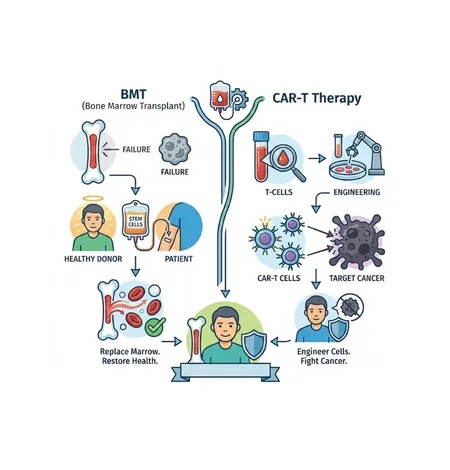
A bone marrow transplant (BMT), also called a stem cell transplant, replaces diseased or damaged bone marrow with healthy blood-forming stem cells. It may use the patient's own cells (autologous) or cells from a donor (allogeneic), including a matched sibling or a haploidentical (half-matched) family donor. Dr Prakash Singh Shekhawat provides BMT care in Jaipur as Head of the BMT & CAR-T Program at BMCHRC.

Understanding bone marrow transplant
Bone marrow transplant (BMT) is a treatment used for selected blood cancers, bone marrow failure, immune disorders and certain genetic diseases. BMT replaces diseased bone marrow with healthy stem cells, restoring normal blood formation. It may be considered for patients who do not respond to standard therapy or who have high-risk disease.
Types of transplant
Autologous transplant uses the patient's own stem cells, collected and stored before high-dose chemotherapy. It is commonly used in multiple myeloma and some lymphomas.
Allogeneic transplant uses stem cells from a donor. The donor may be a fully matched sibling (MSD), a matched unrelated donor, or a half-matched family member (haploidentical or "haplo" transplant), so many patients without a matched sibling can still find a donor within the family.
How BMT is used
BMT is an established treatment for selected cases of leukemia, lymphoma, myeloma, aplastic anemia and immune deficiencies. New stem cells rebuild the blood and immune system and may lead to long-term remission in suitable patients. Careful donor matching, infection control and supportive care are part of modern transplant practice.
When is a bone marrow transplant needed?
Advanced therapy for high-risk cancers and marrow disorders
- Acute leukemia (ALL, AML) not responding to treatment, or high-risk leukemia needing early transplant
- Relapsed or refractory lymphoma
- Multiple myeloma (autologous transplant for eligible patients)
- Aplastic anemia and bone marrow failure
- Thalassemia major and other genetic blood disorders
- Immune deficiencies requiring stem cell correction
The BMT process, step by step
A protocol-driven approach for safe and effective treatment
- Evaluation, staging and transplant eligibility assessment
- Donor selection for allogeneic or autologous BMT (HLA typing of family members)
- Stem cell collection and conditioning therapy
- Stem cell infusion and engraftment in a HEPA-filtered transplant unit
- Monitoring for infections and graft-versus-host disease (GVHD)
- Supportive care, nutrition and rehabilitation
- Long-term follow-up and survivorship planning
Recovery after BMT
Comprehensive care supporting long-term remission and quality of life
- Anti-infection strategies and immune support
- Medicines to prevent GVHD
- Blood transfusions and supportive therapies
- Bone health and organ function monitoring
- Gradual return to daily activities
- Emotional, psychological and nutritional support
- Regular surveillance to detect relapse early
Bone Marrow Transplant care with Dr Prakash Singh Shekhawat in Jaipur
At Jaipur Hematology Centre, Dr Prakash Singh Shekhawat (DM Clinical Haematology) evaluates each patient, explains the diagnosis and options clearly, and builds a treatment plan with the family. For complex cases he works with a multidisciplinary hospital team. Bone marrow transplant and CAR-T, when they are appropriate, are provided under his care as Head of the BMT & CAR-T Program at BMCHRC, Jaipur.
Videos
Frequently asked questions
What is the difference between autologous and allogeneic bone marrow transplant?
In an autologous transplant, the patient's own stem cells are collected and later returned after high-dose treatment. In an allogeneic transplant, the stem cells come from a donor — often a matched sibling, another matched donor, or in some cases a half-matched (haploidentical) family member. Which option, if any, is suitable depends on the disease, the person's health and donor availability, and is decided after a formal evaluation.
What is a haploidentical (haplo) transplant?
A haploidentical transplant uses a half-matched family donor, usually a parent, child or sibling. Because almost everyone has a half-matched relative, haplo transplant makes BMT possible for patients without a fully matched sibling donor.
Is BMT done for thalassemia?
Yes. For eligible patients with thalassemia major, bone marrow transplant is an established treatment that can remove the need for lifelong transfusions. It is usually considered earlier in childhood when a suitable donor is available, so families should discuss it with a hematologist early.
How long does a bone marrow transplant take?
Most patients stay in the transplant unit for several weeks while the new stem cells engraft, followed by close outpatient follow-up for some months. The exact duration depends on the transplant type and the patient's condition; your transplant team will explain your specific plan.
This page is for general information and does not replace a medical consultation. Treatment decisions depend on each patient's diagnosis and condition.